
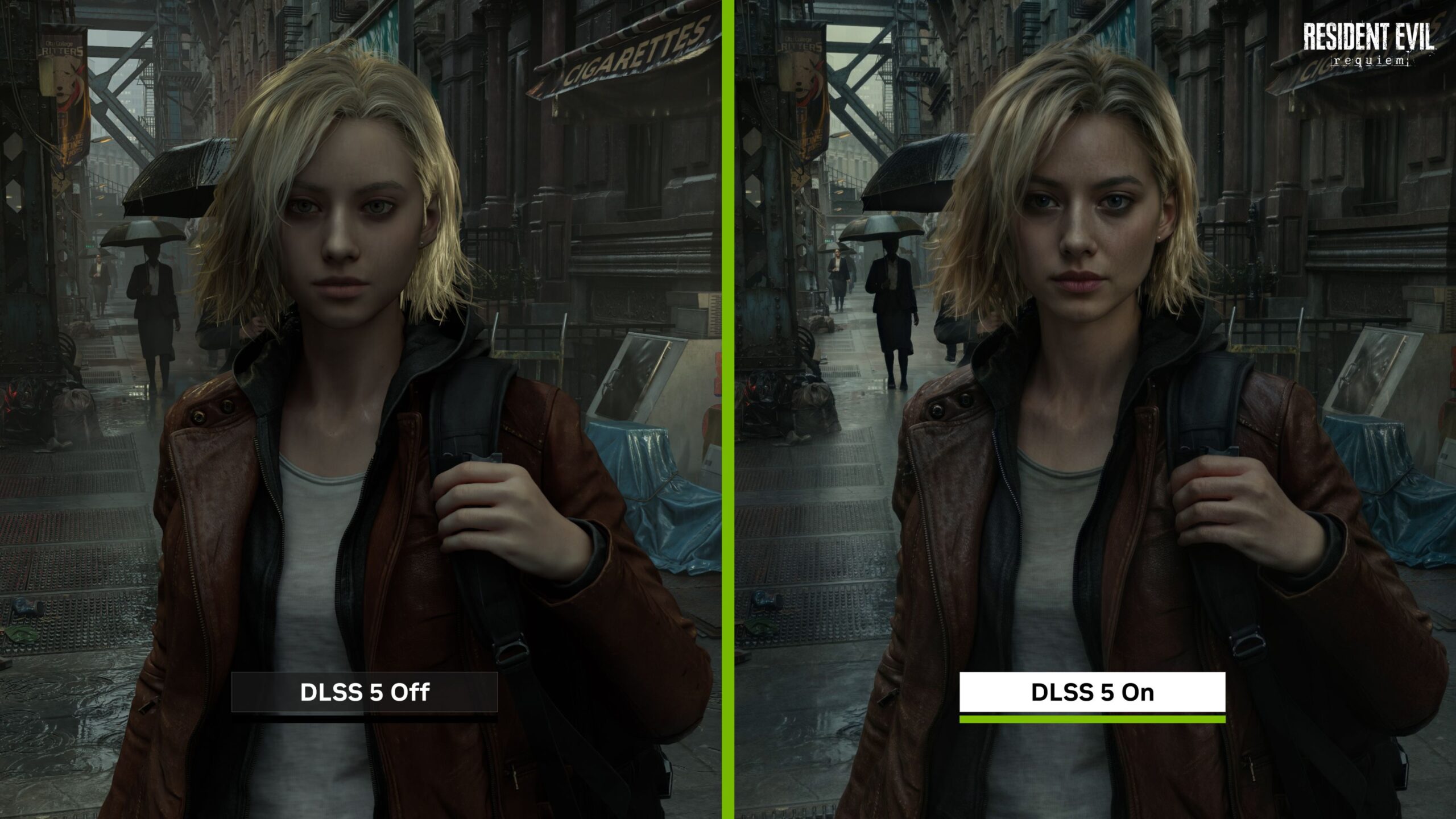
Well, this is a surprise. Just three months into the announcement of DLSS 4.5 and its 31 March rollout, NVIDIA officially announced DLSS 5 just hours ago at its GTC 2026 keynote. Unlike the former, the new neural rendering upscaler will infuse pixels with photorealistic lighting and material and, as Jensen Huang, CEO of NVIDIA, says, “bridge the divide between rendering and reality”.
“Twenty-five years after NVIDIA invented the programmable shader, we are reinventing computer graphics once again,” Huang said. “DLSS 5 is the GPT moment for graphics — blending handcrafted rendering with generative AI to deliver a dramatic leap in visual realism while preserving the control artists need for creative expression.”

Taking the description from NVIDIA directly:
“Video AI models have rapidly learned to generate photoreal pixels, but they run offline, are difficult to precisely control and often lack predictability, with every new prompt generating bespoke content. For games, pixels must be deterministic, delivered in real time and tightly grounded in the game developer’s 3D world and artistic intent.
DLSS 5 takes a game’s color and motion vectors for each frame as input, and uses an AI model to infuse the scene with photoreal lighting and materials that are anchored to source 3D content and consistent from frame to frame. DLSS 5 runs in real time at up to 4K resolution for smooth, interactive gameplay.
The AI model is trained end to end to understand complex scene semantics such as characters, hair, fabric and translucent skin, along with environmental lighting conditions like front-lit, back-lit or overcast — all by analysing a single frame. DLSS 5 then uses its deep understanding to generate visually precise images that handle complex elements such as subsurface scattering on skin, the delicate sheen of fabric and light-material interactions on hair, all while retaining the structure and semantics of the original scene.”
Of course, NVIDIA came with examples, showing off DLSS 5 running on titles like Capcom’s newly released Resident Evil Requiem, as well as older titles, including Hogwart’s Legacy and Starfield. As for our initial impressions of the technology, it’s…well, we’re still on the fence, and we’ve definitely got questions. Using Requiem as an example here again, we can’t help but feel that there is an unnecessary application of detail on Grace’s facial textures. Seriously, the addition of the lipstick feels a little excessive.

And then there’s the overall feel of DLSS 5 as a whole and more precisely, the final look of it. NVIDIA, don’t take this the wrong way – once again, we’re aware of AI being a driving force here – but while the final output certainly looks more detailed, they all look like something you’d get from a Generative AI tool. That includes the bloom and halo effects around characters, main and NPCs, the textures of other assets in the world, and even the background. At this point, we’re just glad DLSS 5 is just an upscaler and not capable of generating extra digits on a character’s hands or even hallucinating actions.
NVIDIA says that DLSS 5 will begin its rollout this fall. The first batch of titles that will support the feature at launch include AION 2, Assassin’s Creed Shadows, Black State, CINDER CITY, Delta Force, Hogwarts Legacy, Justice, NARAKA: BLADEPOINT, NTE: Neverness to Everness, Phantom Blade Zero, Resident Evil Requiem, Sea of Remnants, Starfield, The Elder Scrolls IV: Oblivion Remastered, and Where Winds Meet, and several others.
